Get help

BusinessFreight Class Calculator, free online

Freight class calculator: density and NMFC class for a pallet

Type a pallet's length, width, height and weight: its density and its freight class on the NMFC's density scale (the 13-step scale in force since July 19, 2025), and the class a few inches off the height would give. A whole shipment with Pro.

  • Free, runs in your browser
  • No account needed
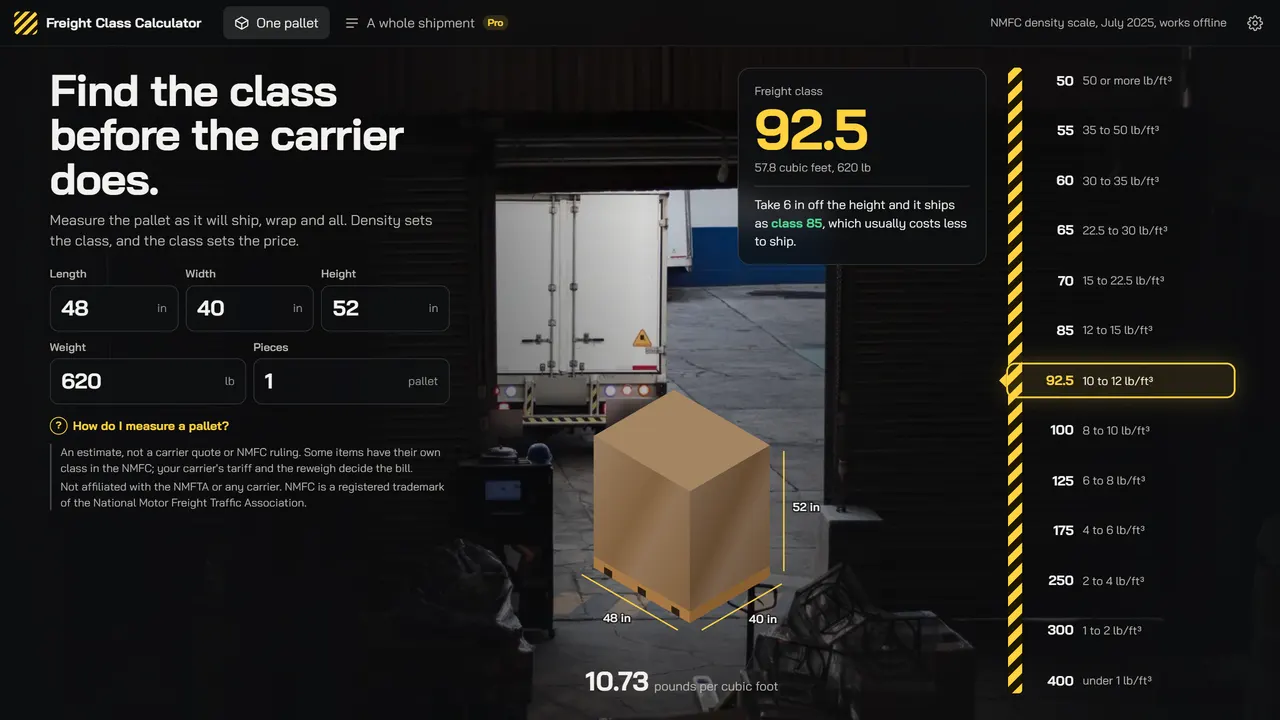
Freight Class Calculator over a dark loading dock with a truck in the open door: a pallet 48 by 40 by 52 inches weighing 620 pounds, drawn as an isometric box on a wooden pallet with yellow dimension lines, 10.73 pounds per cubic foot, freight class 92.5, and a note that taking 6 inches off the height makes it class 85; on the right a hazard-striped ladder of the 13 density classes with a yellow pointer on 92.5.

Features

What it does

Freight Class Calculator over a dark loading dock with a truck in the open door: a pallet 48 by 40 by 52 inches weighing 620 pounds, drawn as an isometric box on a wooden pallet with yellow dimension lines, 10.73 pounds per cubic foot, freight class 92.5, and a note that taking 6 inches off the height makes it class 85; on the right a hazard-striped ladder of the 13 density classes with a yellow pointer on 92.5.

The pallet, drawn to scale

Type the sides and the load grows and shrinks on its pallet in the doorway, with the dimensions marked in yellow and the density counting under it.

  • A ladder of the 13 classes

    A pointer slides down a hazard-striped ladder of the NMFC's density classes, 50 to 400, and lands on yours, with each class's range in pounds per cubic foot.

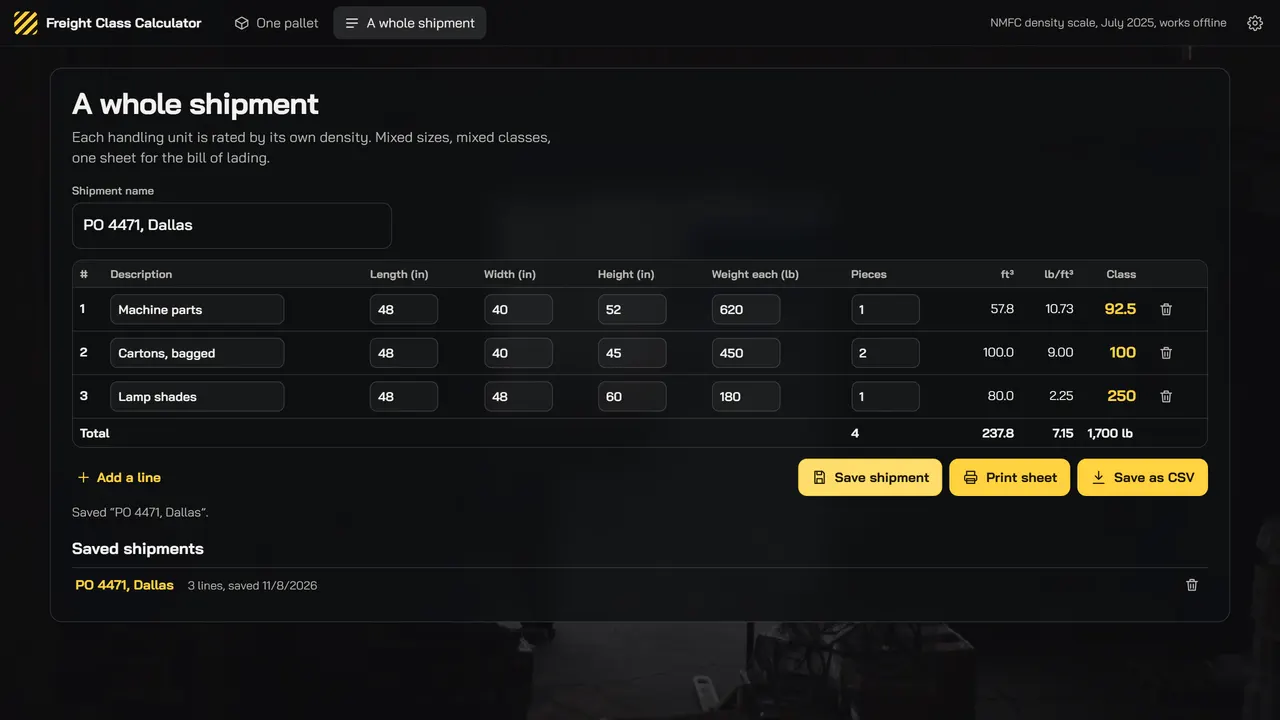
A whole shipment: three lines, machine parts at class 92.5, two pallets of bagged cartons at class 100 and lamp shades at class 250, with cubic feet, density and the total of 4 pieces and 1,700 pounds, and buttons to save the shipment, print a sheet for the bill of lading and save it as CSV.

What a shorter load would ship as

When a few inches off the height would drop the pallet to a lower class, it says how many, so you can restack before the carrier measures.

  • The 2025 density scale

    The 13-step scale the NMFC adopted in Docket 2025-1, in force since July 19, 2025, checked against the NMFTA's own bulletin.

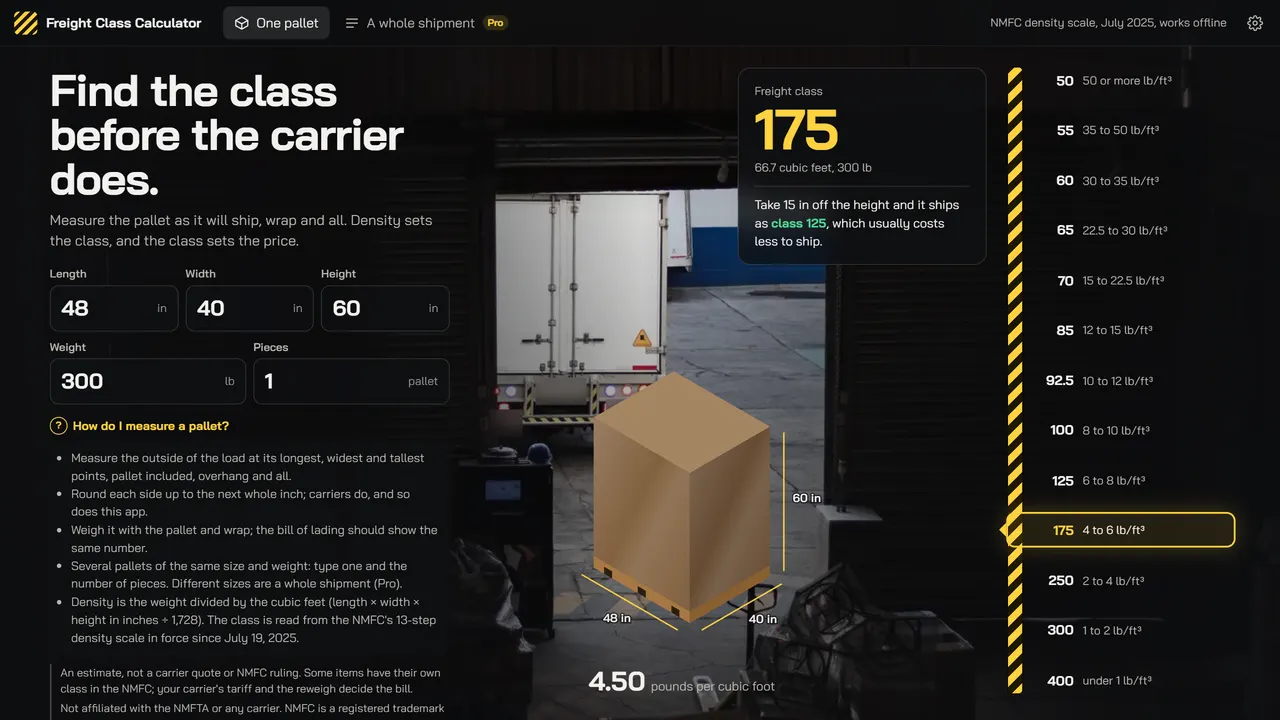
How do I measure a pallet, opened beside a bulky pallet 48 by 40 by 60 inches at 300 pounds: 4.50 pounds per cubic foot, class 175, and a note that 15 inches off the height would make it class 125.

Inches or centimetres

Inches and pounds by default, centimetres and kilograms in Settings; each side is rounded up to the next whole inch, as carriers measure.

  • Pro: a whole shipment

    Up to 30 lines of mixed sizes, each rated by its own density, saved shipments, a printable sheet for the bill of lading, and CSV.

How it works

Three steps, no setup

  1. Measure the pallet

    Longest, widest and tallest points, pallet included.

  2. Weigh it

    With the pallet and wrap, as on the bill of lading.

  3. Read the class

    The density, the class, and what a shorter load would ship as.

Pricing

Free to use, Pro when you need more

Get it free from the Microsoft Store. Pro is a one-time purchase on this website.

Free

$0

  • Density and class for a pallet, offline
  • Several identical pieces at once
  • The what-if for a shorter load
  • Inches and pounds, or centimetres and kilograms
Get it from Microsoft

Pro: everything in Free, plus

$9.99 one-time

  • A whole shipment of mixed sizes
  • Saved shipments
  • A printable sheet and CSV
  • One payment, up to 3 PCs
Buy Pro

Buy Pro here and paste the key into the app's Settings. It works on up to 3 PCs, with a 14-day refund, no questions asked.

What's new

Version 1.0.0

  • First release: type the length, width, height and weight of a pallet and see its density and its freight class on the NMFC's density scale (the 13-step scale in force since July 19, 2025). It is plain arithmetic on your PC, so it works with the Wi-Fi off.
  • The pallet is drawn to scale as you type, and a pointer slides down the class ladder to the class it lands in.
  • When a few inches off the height would drop it to a lower class, it says so.
  • Inches and pounds, or centimetres and kilograms in Settings.
  • Pro: a whole shipment of up to 30 lines with mixed sizes and classes, saved shipments, a printable sheet for the bill of lading, and CSV.

FAQ

Questions

Something not answered here? Ask us and you'll get a reply.

Ask a question
How do I measure a pallet?

Measure the outside of the load at its longest, widest and tallest points, pallet included, overhang and all. Round each side up to the next whole inch, as carriers do. Weigh it with the pallet and wrap; the bill of lading should show the same number.

Is this the class my carrier will bill?

Not necessarily. It is an estimate, not a carrier quote or NMFC ruling. Some items have their own class in the NMFC whatever their density, and your carrier's tariff and the reweigh decide the bill.

Which density scale does it use?

The NMFC's 13-subprovision density scale adopted in Docket 2025-1, in force since July 19, 2025: 50 lb/ft³ or more is class 50, then 55, 60, 65, 70, 85, 92.5, 100, 125, 175, 250, 300, and under 1 lb/ft³ is class 400. It was checked against the NMFTA's Disposition Bulletin 1371.

How is density worked out?

The weight in pounds divided by the cubic feet: length × width × height in inches, divided by 1,728. A pallet 48 × 40 × 52 inches is 57.8 cubic feet; at 620 pounds that is 10.73 pounds per cubic foot, class 92.5.

Is what I enter sent anywhere?

No. The arithmetic runs in your browser. Sizes, weights and shipments stay on your PC.
Get Freight Class Calculator

Type a pallet's length, width, height and weight: its density and its freight class on the NMFC's density scale (the 13-step scale in force since July 19, 2025), and the class a few inches off the height would give. A whole shipment with Pro.

An estimate, not a carrier quote or NMFC ruling. Some items have their own class in the NMFC; your carrier's tariff and the reweigh decide the bill. Density classes from the NMFC's 13-subprovision scale (Docket 2025-1, July 19, 2025). Not affiliated with the NMFTA or any carrier. NMFC is a registered trademark of the National Motor Freight Traffic Association.

© 2026 CAO Labs