Get help

For radio amateursCallsign Lookup, free online

Callsign lookup for US amateur radio

Type a callsign you heard and read its FCC licence as a QSL card: name, licence class, city and state, grid square, and where to point your beam from your station. Check a whole logbook for expired and cancelled calls with Pro.

  • Free, runs in your browser
  • No account needed
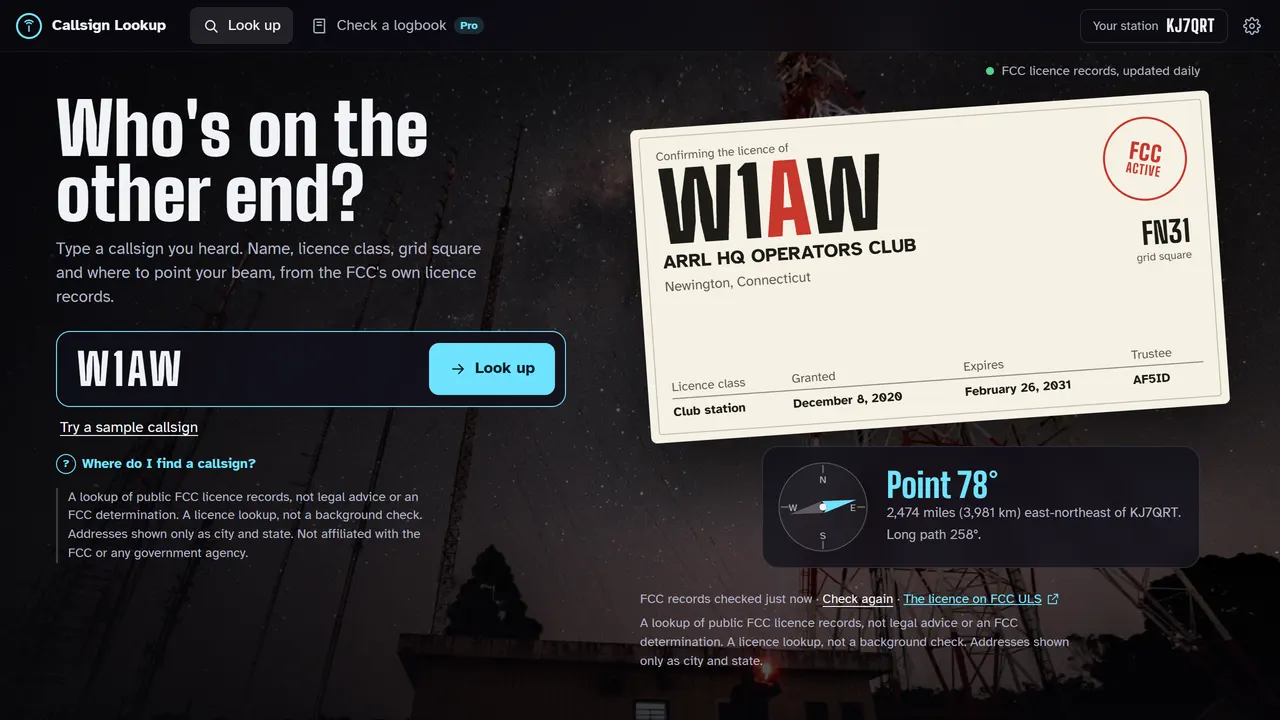
Callsign Lookup with W1AW looked up: a cream QSL card tilted over a night sky of radio towers reads W1AW, ARRL HQ Operators Club, Newington, Connecticut, stamped FCC Active, grid square FN31, and below it a compass says point 78 degrees, 2,474 miles east-northeast of the user's station.

Features

What it does

Callsign Lookup with W1AW looked up: a cream QSL card tilted over a night sky of radio towers reads W1AW, ARRL HQ Operators Club, Newington, Connecticut, stamped FCC Active, grid square FN31, and below it a compass says point 78 degrees, 2,474 miles east-northeast of the user's station.

The licence, as a QSL card

Name, licence class, city and state, grid square, grant and expiry dates and the previous call, from the FCC licence records. Clubs show their trustee.

  • Where to point your beam

    Set your station once. Every card comes with the short-path heading, the distance in miles and kilometres, and the long path.

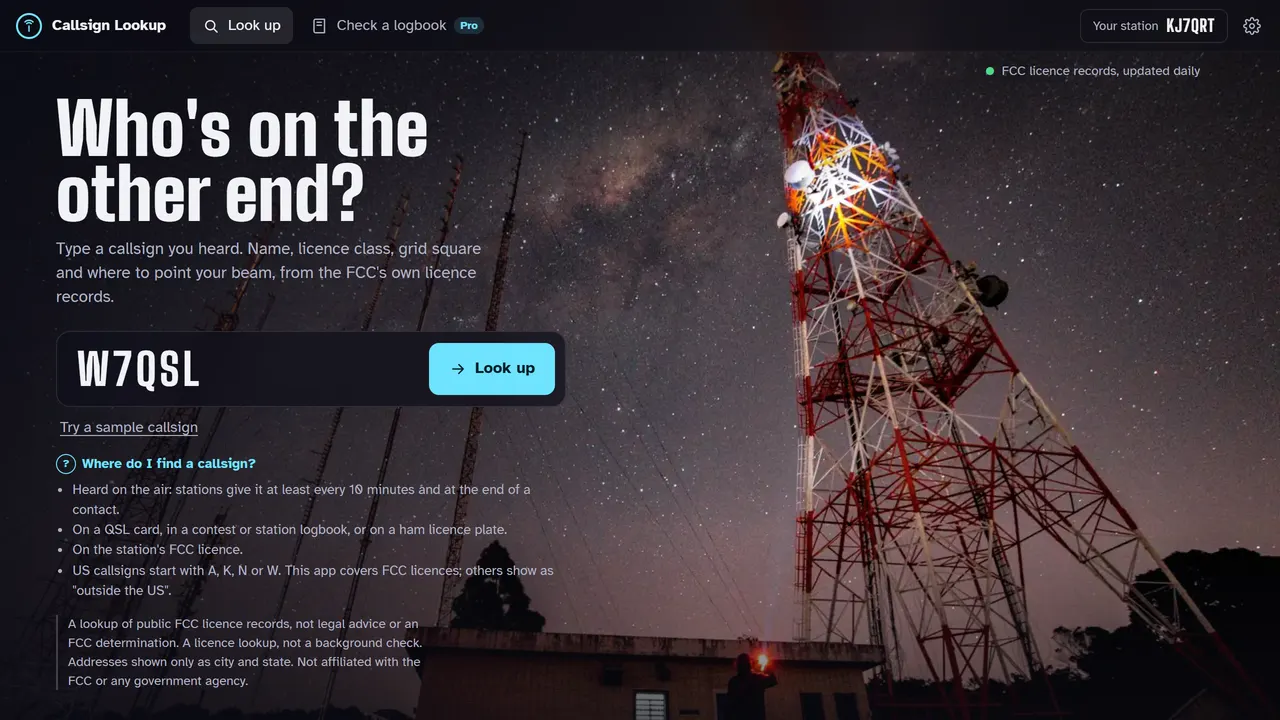
The first screen: the question Who's on the other end?, a big callsign field, and the help that says where to find a callsign, over a photo of a lit radio tower under the Milky Way.

Expired, cancelled, or never issued

The stamp says so, with the date, and whether the call can still be renewed. A call outside the US is named as such, not guessed.

  • Type it the way you heard it

    Portable forms like W1AW/4 or VE3/W1AW look up the licence behind them. The letter that differs from your own call is set in red.

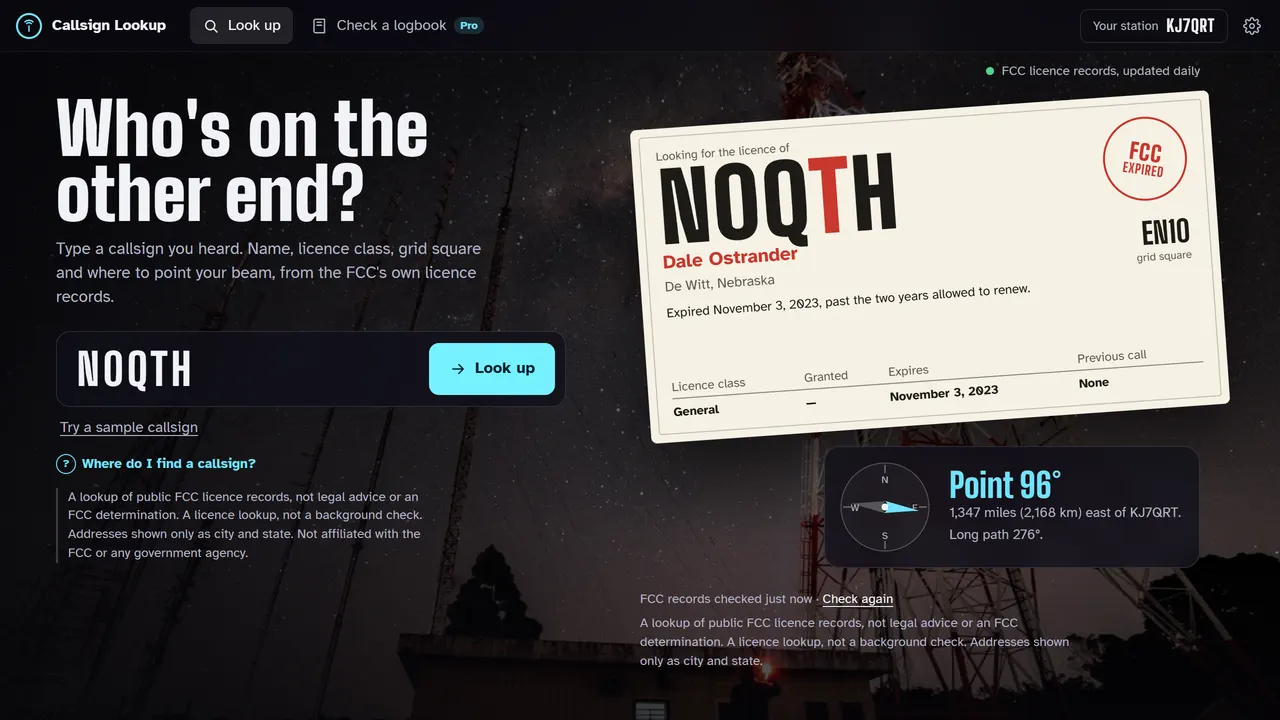
A QSL card stamped FCC Expired, with the date the licence expired and that the two years allowed to renew have passed.

Pro: check a whole logbook

Drop an ADIF or CSV log from any logging program. Calls with no licence, cancelled and expired ones come first; save the result as CSV.

  • Nothing uploaded

    Your log is read in your browser. Only the callsigns go to the licence records, one at a time.

How it works

Three steps, no setup

  1. Type the callsign

    Heard on the air, from a QSL card or a log.

  2. Read the card

    The FCC licence, with its status stamped.

  3. Point the beam

    Heading and distance from your station.

Pricing

Free to use, Pro when you need more

Get it free from the Microsoft Store. Pro is a one-time purchase on this website.

Free

$0

  • Unlimited callsign lookups
  • The licence as a QSL card
  • Beam heading, distance and long path from your station
  • Expired, cancelled and outside-the-US calls named as such
  • Check the first 5 callsigns of a pasted list or logbook
Get it from Microsoft

Pro: everything in Free, plus

$9.99 one-time

  • ADIF and CSV logbooks, up to 5,000 callsigns a run
  • Problems first: no licence, cancelled, expired
  • Save as CSV with status, class, location and expiry
  • One payment, up to 3 PCs
Buy Pro

Buy Pro here and paste the key into the app's Settings. It works on up to 3 PCs, with a 14-day refund, no questions asked.

What's new

Version 1.0.0

  • First release: type a US amateur radio callsign and read its FCC licence as a QSL card: name, licence class, city and state, grid square, grant and expiry dates, and the previous call.
  • Set your station once and every lookup shows where to point your beam, the distance and the long path.
  • Expired and cancelled licences say so, with the date and whether the call can still be renewed. Calls outside the US are named as such instead of guessed.
  • Check up to 10 callsigns at once. Pro checks a whole ADIF or CSV logbook and saves the result as CSV.

FAQ

Questions

Something not answered here? Ask us and you'll get a reply.

Ask a question
Where do I find a callsign?

Heard on the air: stations give it at least every 10 minutes and at the end of a contact. On a QSL card, in a contest or station logbook, or on a ham licence plate. On the station's FCC licence. US callsigns start with A, K, N or W.

Where does the licence data come from?

From the FCC's Universal Licensing System, the public record of every US amateur licence, through HamDB.org and Callook.info, which republish the FCC's files every day. An active licence links to its page on the FCC's own site.

Why does a callsign show as expired?

The licence was not renewed by its expiry date. The FCC allows two years to renew; until then the call stays with its holder, and the card says whether that window is still open.

How is the beam heading worked out?

From the centre of your grid square to the centre of theirs, along the great circle. Their grid square comes from the licence address, so it is the neighbourhood, not the house.

Can I look up a callsign from another country?

No. The app covers FCC licences. A call that does not start with A, K, N or W is shown as outside the US instead of guessed.

Is my logbook uploaded?

No. A file you drop is read in your browser. Only the callsigns go to the licence records, and the result is gone when you close the tab, so save it as CSV first.
Get Callsign Lookup

Type a callsign you heard and read its FCC licence as a QSL card: name, licence class, city and state, grid square, and where to point your beam from your station. Check a whole logbook for expired and cancelled calls with Pro.

A lookup of public FCC licence records, not legal advice or an FCC determination. A licence lookup, not a background check; addresses are shown only as city and state. Licence data from the FCC Universal Licensing System via HamDB.org and Callook.info. Not affiliated with the FCC or any government agency.

© 2026 CAO Labs